Blogger Template by Blogcrowds

Showing posts with label Global Ethics. Show all posts

Civic Responsibilites

Thursday, February 19, 2009


Joel Westheimer and Joseph Kahne write about civic responsibilities in their article, Educating the "Good" Citizen: Political Choices and Pedagogical Goals. In a democratic age, how can people be educated to be good citizens? First, what makes a democracy successful? Schools help students to develop a character that is respectful of the law and of other individuals. The minorities, when educated, can start to take action to reach their objectives. Or maybe democracy should be taught, with all its centuries-old ideals.

Essentially, the types of "good citizens" we need to support a democratic society could be categorized into three; the personally responsible citizen, who is responsible in his/her community by working, paying taxes, obeying the law, recycling, donating blood, and volunteering to help others during times of crises; the participatory citizen, who seeks improvement and is actively engaged in his/her community's organizations, knows how government agencies work and strategies for accomplishing group tasks, and lastly; the justice-oriented citizen, who with experience can critically judge and assess social, political, and economic structures, acts on justice, and is familiar with social movements.

Which one is more important?

As far as schools are concerned, students who are steered more in the direction of volunteer work and charitable activities don't know as much about politics, social movements and transformation, and systemic change. Schools who put kindness as their priority overlook social action and justice. Of course there's the other side too, those who know all about justice and democracy, but won't take any action to correct the faults they see. Can there be a balance; is it possible to have all three kinds of these visions?

Those people who are involved in educational curricula should be aware of this and choose carefully in order to foster good democratic citizens for our future.

I think we're doing a good job in HIS by encouraging students to be just and kind, helping and respecting other students in our small school community (although I'm a bit disappointed that community service was taken away, even though I wouldn't be able to go anyway). We have a fair amount of justice-oriented teaching too, as we talk about human rights, women's rights, and major social movements that made our world the way it is today. In my opinion at least, what we lack more is in the area of "participatory citizen." We always learn and discuss about issues and how we could contribute to its improvement or solution, but we rarely take any significant action.

Innovation

Monday, February 16, 2009
"The world needs crazy ideas to change things, because the conventional way of thinking is not working anymore."

This could not be any more true, and that is why two women in New Delhi went on a road tour around India this year, stopping in fifteen cities and dozens of villages, in a plug-in electric car that is also powered by solar panels on the rooftop. They went around making people aware that change is happening now, and if we take action, it is possible to replace our fuel-consuming and environment-polluting things with cleaner, innovative technology to contribute to climate solutions. 

I think what they did was really amazing, just two people undertaking such a large and noble project. They're not just talking about what we could do, but they're actually doing it. There are already many energy solutions starting in India, but they're spread far apart; this trip brought them together and showed people that these ideas are not that far off and out of reach.

Sex and Gender

Thursday, February 12, 2009

( ^ This is a man, btw. ^ )


Could playing with cross dressing be healthy and why?
Cross dressing could make one more open minded about expressing oneself in different ways, but I don't think it's necessarily healthy or unhealthy to do it. Some people are comfortable being their own male/female selves, and others find cross dressing a fun activity. The benefits really depend on each individual, in my opinion.

Is cross dressing more difficult for boys or girls and why?
It seems like it's more difficult (but also more fun) for guys to dress as girls. We always see girls wearing pants and loose tee shirts, but it's really quite a sight to see a man in a skirt and close fitting clothes. So to see a girl cross dressing, it's not as surprising because it's not that much different from what many girls usually wear. We also see more "tomboys" than feminine boys.

Can gender binaries be blurred? And if so, what are the consequences?
It can be, and it is being blurred. I don't think there are any men than don't have even a little bit of femininity, and girls that don't have the least bit of masculinity. Maybe it's subconscious, but it's definitely there, and if encouraged by certain situations (like cross dressing) it becomes easier to blur that line between the male and female sexes. Since it's happening right now, the consequences can be seen anywhere and everywhere, but on a larger scale, people might not accept it or be comfortable with it at first. But people now, especially the younger generation, are becoming increasingly open minded and things like these are acceptable and no big news.

Ideas for Innovation

Monday, February 9, 2009
  • No. 1: Spur greater parental involvement.
  • Parental involvement seems like a good idea, but overdoing it isn't. I think this should be something optional, but always available to parents if they're interested. Having a school right next to a company isn't too much of a thrill, though. Having parents visiting the school during lunch breaks just seems a little weird. If my parents were to get too involved with our school, it would put more pressure on me as a student. I just think there needs to be a balance.

  • No. 2: Make schools smaller.
  • I think everyone at our school would agree that there are many benefits in a small school. Students get more individual attention, it's easier to talk to faculty and everyone knows each other. All these things can help a students not only academically, but emotionally as well. In bigger schools, sometimes there are more problems, too many problems that the authorities can't handle. But on the other hand, a smaller school means less competition. Some people need competition to bring out their true potential.

  • No. 3: Utilize community service to foster civic engagement.
  • Community service not only helps other people (the community) but is also beneficial to the person volunteering to do the service. On many occasions I have learned valuable lessons from doing community service, and these things can't be learned from a textbook in the classroom. Learning the importance of this early on really changes a person's perspective on it, and it can become something to look forward to rather than a chore. It would be great if everyone could go into society with this kind of mindset.

  • No. 4: Teach civics effectively in schools.
  • This is useful knowledge to have, especially when students become adults and have to deal with things like these in their lives. Getting students involved early on by incorporating real life scenarios, using things they care about, is a fun way to learn civics.

  • No. 5: Fund extracurricular activities.
  • Extracurricular activities are very important. They can help a student with skills they already have and would wish to improve on, or find new interests that they didn't know of before. Overall, it helps one become a more well rounded person. Without extracurricular activities, something would just be missing from the school experience.

  • No. 6: Model a high school on a community.
  • I really like this idea. It prepares students for the real world, and doing things like this makes them take on whatever their task is with responsibility and maturity. It's a good experience.

    The End of Suburbia

    Thursday, December 4, 2008

    "Reality is bad for business; what's good for business is the fantasy."

    It's common knowledge that fossil fuels are finite, but did you know that they will run out in our lifetime? After World War II, Americans invested their wealth in the suburbs where they could lead a peaceful life with their family, away from the noise and chaos in the cities. The suburbs are like dormitories, and there is nothing but houses for miles. In order to get to work or shop, people had to drive cars everyday to get to the city. This kind of lifestyle required cheap fossil fuels, and at that time they were abundant.

    Decades later, resources are running out. We're passing the peak period of the best oil extraction, and we're going on a descending slope. But still, we're living the same as before, ignoring the fact that this can't go on much longer. Even though I'm aware that fossil fuels are quickly depleting, I've never considered what we should do when the day that we can no longer rely on oil and gas finally comes. No kind of energy can replace these natural fuels.

    The thought that someday everything we do will have to become local is really shocking. If, for example, the US and China become competitors in getting hold of the remaining bits of fuel, then they will no longer do business with one another, and considering how many things are made from China ("from pants to underpants"), Americans will have to be prepared for a big change in their lifestyle. I couldn't imagine what life would be like if Taiwan had to be self dependent. A lot of the things we use are imported from overseas, including food and clothes.

    Before I watched this documentary, I also never really focused on all the things that require natural fuels. The most common things that come to mind are mostly transportation and the like, but foods processed in factories need a lot of energy too.

    If I was an American, I'd probably be even more shocked than I already am. As far as I know, there aren't many suburbs in Taiwan, but even so there are a lot of cars (and scooters) that use up gas. Taiwan is rather tightly packed and you can go to any place in a matter of minutes (no matter where you live, there are restaurants near by, shops nearby, etc).

    Personally, I wouldn't want to live without imported products from other countries, just because I'm so accustomed to having them in my life. This fuel crisis makes me wonder about the future, how we will get around. Will traveling (especially by plane) become an extreme privilege? Will the world revert back to the time when the planet seemed bigger because it was harder and took longer to navigate? If things will become local, what kinds of new jobs will be created, and which ones will no longer be of use?

    When we think about the future, most people draw up images of advanced technology, wondrous sources of energy, and diversity everywhere. With the oil age coming to an end, what will our next source of energy be?

    Microwaveable organic TV dinner!

    Monday, December 1, 2008


    We watched a documentary two classes ago about Enron, a powerful corporation that went corrupt and eventually fell. Then we read a chapter titled Big Organic from The Omnivore's Dilemma, a book written by the American writer, professor, and activist Michael Pollan.

    I never thought much about labels, and it was interesting to see it as a literary experience. It takes a special kind of skill to market a product through writing. But it's true, when I see something labeled organic, I draw up a very nice mental image of healthy flowers and happy cows. The descriptions are wordy and descriptive, tricking the consumer into assuming imaginary facts. You may read, for example, that the chickens grown at a certain farm are "free range," and it sounds good to the average buyer, but if they don't specify "free range," it might mean only having the chickens spend a few days or weeks out in the open. In a way, they're abusing the word "organic" to better sell their products.

    Enron is similar in that it never tells the public the details of its profits, or even details of what they do. It shows you the final result (numbers) which isn't even true, which is similar to the vague labels. In both cases, whatever is shown to the public is what the people want to see and believe, what sells, but in the end all the things behind these vague figures are lies.

    In my opinion, "organic"and "industrial" are words that can't go together. In my mind, they don't make sense as a single idea. If organic means going back to the roots and having a more direct connection with the natural, I can't imagine it being done at a large scale... at least not at the moment. Once you cross a certain number limit and industrialize, measures are taken to make things more efficient in space, time, and money. Everything has to be made precise, like the "mosaic of giant colored blocks" that are carefully and precisely cut. How does this pattern follow nature?

    I think it's very possible for an organic farm to be successful, but many fall victim to bigger, industrialized companies, who only want produce at a large scale. Organic farms, however, can produce a large quantity but with different varieties. Since this is not "convenient" for big stores like Costo, Wal-Mart, etc., small farms like these usually have it harder. It's easier to submit to do things the fast way with quick and visible results. Since this is what people demand, it will slowly change to fit their needs.

    Organic farms are understandable. They're in a tight spot. But Enron? They had a choice to do things morally, but they chose to lie instead. They should have known that, like chemicals that quickly produce beautiful plants but destroy the soil quickly as well, the effects are short lived.

    Enron

    Thursday, November 27, 2008


    Where are Kenneth Lay and Jeffrey Skilling now?
    Ken was going to go to jail, but he died of a heart attack during a vacation trip in Snowmass, Colorady, three and a half months before his sentencing. Jeffrey Skilling's defense attorney is still trying to help him out of this situation, but the chances of him getting through this are very slim. Skilling is currently in a prison in Littleton, Colo.

    The Effect of "hubris" in the Enron debacle.
    According to the WordWeb dictionary, the definition of hubris is overbearing pride and presumption. Because of their pride, they lied to the board of directors, bankers, and their own employees about what was going on in the company. Assuming that lying about their actual profits and whatnot and thinking that everything will be alright, and everyone will be fine with it, is a huge presumption. By hiding all these things from the public for its own image and personal profit; this was the hubtis that led to Enron's downfall.

    Reflections on the movie.
    Yet again, like the article about Science Park, this large corporation is trying to cover up the truth. For the past year, we've also seen groups and businesses hiding the reality from everyone. For example, there were the food industries where workers were mistreated as well as the animal stocks. In the end, everyone is trying to hide their bad side, especially corporations that want to sell and succeed. The case of Enron was an extreme example. I kind of feel sorry for Lay and Skilling, though. Once you make a lie, you have to keep on making lies forever to support the previous ones. By the time they realized it was getting bad, maybe it was too late for them to back out.

    Designing our Future

    Thursday, October 16, 2008


    Hawken's Opportunity of Insignificance and William McDonough's TedTalk both relate businesses and the environment in some way. To be honest, I can't seem to grasp any especially strong connections between the two, probably because they both had too much information to fully understand and then compare... so I'm trying my best here to write out what I think was important to me.

    As we talked about in class last time, their purposes tie in with Ishmael, the idea of takers and leavers. What they're trying to do is to lessen the taker culture and not take so much from our environment so we will be sustainable and leave enough for the many generations to come.

    If we want to change, it's hard to say "let's do it", and then do it. Everything has to start from the source and the design from the very beginning. Hawken wrote about medicine and how the process is now, the way that's promoted is that when you get sick, you buy medicine or go to the hospital, and it actually takes up more resources and money to do that rather than research and use medicine that will protect us from getting sick in the first place. We should support the new ideas of making new designs with good intentions behind them that will help our planet's sustainability.

    Something that also stuck to me is the definition of "growth" and "development". What most corporations are doing and striving for is "growth", but what we should really be aiming for is the quality and long-term improvement in development. Starting with intelligent designs, we'll be able to make good business and good environment co-exist.

    Waste Not

    Sunday, October 5, 2008


    Waste of money, waste of people, waste of resources... there is so much waste everywhere. With civilization advancing every year, we might think that we're better off, we lead much easier lives than the people in past generations-- but is that really true?

    A pack of food, or a can of soda, travels to many places and goes through a long, complicated process before it gets to the buyer, who consumes them and discards them in a matter of minutes, throwing away all the work, time, and materials put into it, wasted.

    There is traffic jam, you're stuck indefinitely behind a red light. Besides the waste of gas and electricity, there's waste of time. We think we have better jobs now, but a lot of people aren't so lucky and end up wasting their talents because they have no other choice.

    In short, things are wasted everywhere, all the time. If I had to tie this idea to my senior project (media), it would be about how the media influences the society and tricks our minds into doing things we believe are good and productive, but in fact are a waste of time, effort, etc.

    Many trends are advertised in the media, whether they are popular words, accessories, or even ideas. All these things try to shape people into something they're not, and somewhere in that process people lose their own identity. Isn't that a kind of waste that we should be more aware of? Media is fast-paced and changes all the time, including the things it promotes. iPods will be in fashion today, and then iPhones tomorrow. People will feel the need to buy the latest, even if they don't need all the new functions of a newer version. This happens with almost every product, and the old ones are thrown away without any valid reason other than "it's old"... and there's something new. If we add together all the little things that we've replaced or changed, we end up with a lot of waste in all forms.

    Senior Project = Corruption, condition, distortion

    Thursday, September 25, 2008


    The general subject I want to work on for my senior project centers around the media and its effects on our society as well as individuals. It's a widely debated topic, but it's also something that really bothers me personally.

    Media is something that informs and entertains, but at the same time it can discreetly (and sometimes even blatantly) brainwash the people that are exposed to it.

    There are mainly two things that I want to focus on in this post (there will be more as I do more research on this subject), the society's standard of beauty and people's materialistic "needs".

    We like looking at beautiful things, and that is fine, but it becomes twisted when you try telling people that there are "guidelines" to be beautiful. Have you ever seen stunning women or handsome men on the cover of magazines? Or gorgeous people on television or promotional advertisements on the streets? They are nothing like the people they really are. Make-up "pretties" them up considerably, and the rest is professionally Photoshopped to fit the stereotypical image of beauty.

    I find this especially depressing for women because we really have to worry about our appearance thanks to the values the media advertises (although nobody looks like their Photoshopped models). Our hair has to look a certain way, we have to dress a certain way, our skin has to have the "right" tone, our eyes have to be big, full lips, big breasts, small waist, double eyelids, nicely shaped face, eyebrows, etc. When women don't fit into these specifications, they will get plastic surgery, buy products to re-shape themselves, spend excessive money to buy products for hair, skin, etc. We will never get naturally airbrushed skin and Lux commercial hair, or any of the things I mentioned before for that matter, but we strive to get as close to them anyway.

    Moving on the our materialistic "needs". I put needs in quotation marks because most of the things we buy aren't really needed, we just want them after being influenced by the constant advertisements around us. By saying this I'm criticizing myself too, because as I'm looking around at the things in my room, there are a some little things that I felt like buying at the moment because they were "in", and the constant reminders on television and ads were very tempting.

    It's especially annoying when there are new brands or versions of the same thing. Whether it be computer software, house appliances, electric devices, or clothing, there is always something new around the corner and you'll always want to have it because it's all that you see all around you, luring you quietly.

    The Silence of Silicon Lambs

    Thursday, September 18, 2008


    My first thought on the article was shocking. After reflecting on it a bit further, it became hopeless and disturbing. I didn't know much about Science Park to start with; any information would have been new and surprising, but what I do know is that it's one of the things/places Hsinchu is most well known for. It's one of our prides, and it's one of those places that gives a person an automatic promotion in status, making people gasp in awe, just for working there.

    In this clean, reputable place, I never thought it would hide any dirty secrets. On the other hand, there are few corporations that are more environmentally friendly than they are harmful, so I guess you could say it was only to be expected. The powerful, flawless image is just something we want to believe.

    To be honest, what they did didn't bother me so much as what they chose not to do. Sure, endangering people's health and the environment is not to be taken lightly, but what really angers me is the fact that they try to cover it up so the public doesn't know about it. Being able to control the media to hide the truth, even for the good of our image and economy, is something I've always been and will always be against.

    Change the World

    Saturday, April 12, 2008


    Our world is getting smaller and smaller, and today we can accomplish things that just a hundred years ago people would have thought to have been nearly impossible.

    I don't want to be famous, or rich, or put down in history that will live on forever in books. In fact, I don't want many things at all. I just want to do the things I love doing and be with the people I love being with for the rest of my life. But while I'm here, I also want to make a difference in the world. Whether that difference will affect just one person or millions of people, I want to leave a mark that is worthwhile, something that I can look back on with a proud smile.


    I want to make the world...
    A little brighter,
    A little happier,
    A little more peaceful,
    A little more colorful,
    A little less complicated,
    A little less twisted,
    A little more open minded,
    A little more creative,
    And a little more magical.

    I will put my heart and soul in my work, I will show the world the wonderland that every child eventually leaves behind. Everyone has to adapt to survive in this cruel world, and as we're shaped by the values and expectations of our society, we become blind to happiness, the kind of happiness that is in its purest and simplest form. Children can be happy just for the sake of being happy, and that's why their laughter is the most beautiful. I hope I can remind people of this innocent joy, convince them to slow down to take a good look around and enjoy life instead of rushing through it to get to wealth and success. We only have one life to live, and we must make the best out of it by making it our own adventure instead of following the crowd on the road that others have paved.

    Timothy Treadwell

    Monday, March 17, 2008

    Timothy Treadwell was an environmentalist, a documentary film maker, and the star of Werner Herzog's universally praised Grizzly Man. After watching the film, I was left with two very different impressions of Treadwell. With his jumpy, bubbly, slightly narcissistic demeanor and a strangely child-like and dramatic pattern of speech, I was sure this guy was either on drugs, or simply a lunatic on a rather interesting mission.

    What was his mission, anyway? To protect the bears. Kind of odd, if you think about it. The grizzlies are probably as safe as they'll ever be in the Katmai National Park and Preserve. By spending so much time with the bears at such a close distance, Treadwell was putting not only himself in danger, but also other visitors and the bears themselves. The rangers in the park do their best to keep the bears away from any human influence, and so when people approach the bears, they are usually calm and uninterested. Treadwell's constant "interactions" with the bears could very well have upset that conditioned immunity to the human presence. In a place where they're trying to preserve species in their natural habitats, it's probably unwise to have a human (who I'm convinced has some issues up in the noggin) roaming around.

    I found it extremely amusing how Treadwell liked to befriend every animal, but I'm not sure if that's a good thing. He had trapped himself in a delusion that the bears had almost accepted him as a companion, a protector, when in fact his affections were unrequited. I believe that this idea played a crucial role in his death. He thought the bears recognized him and needed him, and he let himself be too defenseless. It's true that the season was bad for fishing when Treadwell was eaten, but I wouldn't be surprised if the cause was something else (like the bears had lost interest in this weird little blond creature that stalked them all the time with a freaky voice and an oddly shaped rock that sometimes had three legs).

    Few people would willingly give up everything and risk their lives out in the wild among creatures that could easily take down a well-built man, but I think this was Treadwell's salvation; his only escape. After his dreams of being a Hollywood actor were shattered, he turned to drugs and his life was a chaos. Perhaps he sought for a simpler life, and he found that kind of comfort in the wild with the bears, which coincidentally he had a tremendous fascination with.

    Despite the harm and troubles he brought to the animals and the Alaskan park's authorities, Treadwell had good intentions and he did do some pretty darn good things. His breathtaking footage of nature and the animals is proof enough, and he also taught kids in school about his experiences in the wild. He was brave and determined, and I respect and admire him for that, but there comes a time when under such circumstances, too much bravery and determination can be reckless.

    Arctic Tale

    Monday, March 10, 2008

    This film tracing the life cycle of polar bears and walruses is amazing. It let me see so many things in their lives up close. Compared to their life-and-death struggles for survival, our problems seem so petty, and we're not doing much good contributing to global warming either.

    There were so many signs of emotions throughout the documentary, and at some points I could clearly imagine a human being experiencing the same emotions as the bears and walruses. In fact, they seem to be able to express themselves better than us.

    When Nanu's brother was too weak to walk any further and quietly died, his mother and sister snuggled by him for hours long after he had passed away. I guess they were mourning in their own way. The other scene that struck me as a very painful one for both mother and daughter was the parting, when the mother polar bear suddenly became distant from her cub, realizing that they would have to go separate ways if they were to survive in the harsh conditions.

    The walruses are one big family and always stick together through the good and the bad. Sure, they move in groups on their instincts to survive, but they also love and take care of each other. When a predator comes, a walrus doesn't swim away alone but goes and warns the others before escaping together. Their love and devotion is best shown when the auntie sacrificed herself to save Seela, who also responded with a sad and anticipating gaze as she waited for her auntie.

    I'm not sure how I'd describe this feeling, but there must have been something when Nanu approached the male polar bear's food. He threatened her at first, but he let her take what she needed in the end. He could have killed her easily if he had wanted to, but he didn't. Even if the conditions weren't so bad it would have been hard to catch a prey, so why would he have given up his? Pity? Empathy? Resignation?

    I used to think that animals don't mate for love, but just to have offspring. It was interesting to see the picky Seela courted by the many young walruses. She chose her mate by his voice? I wonder if they'll grow to love one another so much that they'll sacrifice themselves for the other like auntie did.

    Vending Machines... [Just random musing.]

    I'm starting to suspect that they're deliberately made so they'll eat some of your money every few coins. You leave it there for a few hours, and it's fine again. How does that work?

    Fast Food Nation

    Sunday, March 9, 2008

    Last semester when I watched "Meet Your Meat", I couldn't eat meat for nearly a month. Even the faintest smell of beef, pork, or chicken would make me lose my appetite. When I watched Fast Food Nation, I got that same feeling again. It's probably one of the most convincing films I've watched, one that sticks to me for a long time and actually has an effect on my life. My first reaction to all this was... "disgusting". The two realities that bother me the most are the treatment of animals and the Mexican workers. I seriously don't know which one of them have it the worst.

    I hate to think that every time I'm at a restaurant eating a beef burger or a chicken breast, having the most wonderful time with not a care in the world, on the other side there are poor animals who never had a chance to live a real life, were tortured, and killed mercilessly. There are also the workers who have no choice but to endure slaying, skinning, cutting, and cleaning. As if dealing with raw meat, guts and gore wasn't enough, these workers have to be worried about their safety every second. It must be horrible knowing that one clumsy slip could lead to a missing finger, arm, or leg.

    Although I can't deny that I don't eat meat, I really want to do something for their cause after watching this film. I don't want to live in a world where people are treated like worthless machines, and an animal's fate is to suffer from the day they're born.

    Expedition 2 Question


    a) Do we have an ethical responsibility toward animals? b) Do animals have emotions? Give examples if possible.

    If this was thousands of years ago, we would have no more responsibility toward animals than a dog would toward a cat. I'm not saying we should be responsible because we are superior beings, but simply because we have done them harm, and we have to take responsibility and fix that. We have caused many species to go extinct, many to move out of their natural habitats, and many were killed for human benefits. I personally feel that we "owe" them in some way.

    I believe animals have as much emotions as humans do; maybe not so many in variety, but they still have feelings. I'm not sure about all animals, but the ones I'm more familiar with definitely display their emotions. The most common example would be the dog, man's closest friend. Dogs can be jealous when you have too much attention for something else, they are lonely when they are left alone in the house, and they will "mourn" when their owner dies. I think animals and humans have more or less the same kind of emotion; it's just that humans know how to express themselves so other humans can understand. Like dogs understand other dogs, even if they speak to each other.

    The Gods Must Be Crazy


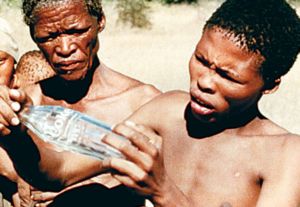
    I think this film relates mostly to the point Ishmael makes about the Taker’s views on the Leaver culture. We see here that civilization and advancement in technology is not as good as we think. Xi in this film represents the bushmen and the Leavers, and they are a happy family, without the restrictions of laws, punishment, or crime. They don’t even have a word to express “guilty”. They are a peaceful little community. The adults share everything, their tools and resources, and the children play cute and inventive games (whereas in Taker culture the children tend to have a more violent nature towards playing and the adults cling to their possessions with greed).

    These people live an almost carefree life and have no sense of time (there are no Mondays, Tuesdays, Wednesdays, and so on) and contrary to Taker belief, they don’t live in fear of being preyed on (in fact, there are scenes where they are perfectly content walking amongst other animals). To find food of their own is no hard task either. They have tools such as anesthetic arrows of some kind that paralyses the animal. And to reinforce the fact that they are such a peaceful people, there’s even one part where the bushman apologizes to his unconscious prey and tells it that he had to kill it or his family would starve. The bushmen don’t worry or fear because they live in the hands of gods. Everything that happens, good or bad, is a result of gods’ works; when the Coca Cola bottle appears, they say it’s something the gods gave them.

    Back to the Takers’ world—the movie makes a huge contrast on the two different lifestyles. Everything is rushed and there is an exact time for everything. As for killing, the people kill others of their own kind (the Leavers only kill their prey). If you look at these two cases, you would much rather live in the bushmen’s gentle and peaceful family rather than the chaotic Taker society. From Xi’s point of view, the Takers must be a stupid people because they have so much technology, but they would not be able to survive without them, and that is why the Takers cling on to it so tightly. They wouldn’t be able to survive because they are no longer living in the gods’ hands and therefore the gods don’t provide for the Takers.

    The bottle that the bushman finds appears as an embodiment of the evil that comes from civilization. With it comes anger, jealousy, and hate. The bushmen may seem naïve to us, but they are pure and can see something that we are blind to; chaos. And yet we choose to live in this box of chaos; even if we had a choice to live otherwise, we would still cling to our culture.

    At the end of the film, after Xi has helped Andrew, Kate and the others, you get a sense that it is possible for the Leavers and civilization to co-exist (if the Takers didn’t have the nature to wipe them out first), but they will never understand each other save for some few people whose careers are out here in the Leavers’ homeland. One of the most important things here I think was the bottle. The bottle brought all these bad things to Xi’s family, and in a way I see it as a metaphor that the Takers are corrupted, therefore the things they make are also corrupted, and not only are they confined to corrupt themselves but they also corrupt other peoples. If it hadn’t been for Xi’s decision to get rid of the bottle, the friendly and peaceful family of the bushmen might have been ruined. On a larger scale, the Takers are on a path to destruction as well. We might not see it, but it was shown very effectively in the film because of a large contrast with the Leavers. The bushmen had time to turn back, but we might not be so lucky. If we don’t get rid of our “evil thing” soon, it might be too late to save ourselves from being ruined.

    Ishmael: The Laws of Life


    It still amazes me how the narrator managed to figure out the laws in merely four days (although the first one wouldn't really count as he spent the entire day telling himself he couldn't do it, and I don't blame him). I thought it was pretty hard when Mr. Loken asked us to guess what the laws were. Some people obviously read ahead and re-phrased what was in the book, but for those who didn't, it must have been a difficult exercise; there are so many things you wouldn't know where to start.

    I thought it was very clever of the author to use the laws of gravity and aerodynamics as a parallel to the Taker culture. One of the things that is sending us hurling fast into the previous fallen "aircrafts" is the fact that we're fighting a natural law, and believing in that decision so blindly that we don't even know we're heading towards our own doom. I seriously believe that all the leaders in the world should read Ishmael. One of the worst mistakes we're making is encouraging more population growth. Like we discussed in one of our classes, when an area is struck with poverty the first thing we do is send them food, yet we pay no attention to their frighteningly high birth rates. Because we take so much for ourselves, there is no balance like in the Leaver world where competition is actually a good thing and a crucial and necessary part to make the laws work.

    However, it's one of those things about being in our current society that makes us feel that if we don't feed people, it's like "killing", it's morally wrong. Another thing that I wanted to point out is that in our society, food is not only a necessity but a kind of pleasure. For those who can afford it, eating excessively isn't a problem. In the wild, they just eat enough so they can survive.

    Something interesting that I had been thinking about when the narrator and Ishmael were discussing about the laws is that generally we give animals almost human characteristics. We think that competitors are enemies, and so are the predators with their prey. Many of these misunderstandings are shown in fiction and just usual conversation.

    While reading Ishmael, I'm always thinking to myself why if we know what we're doing wrong already, why don't people do something about it? The book puts things out simply, but in reality it's much more complicated. It's not easy to change. With the mentality we have, living like the Leavers would be like a taboo; we'd be "regressing". After centuries of inventions, discoveries, and an incredibly large amount of time dedicated to gathering knowledge-- I don't think we're ready to do that.

    WalMart: The High Cost of Low Price


    "Life is unfair."

    I've often heard people say that, but what would be more accurate would be "The kind of society we live in is unfair." A place where the rich become richer and the poor become poorer will never be a peaceful place to live in. It's a sad day when politicians and big companies work together as one, destroying all the other small things in its path to economic glory.

    This whole documentary tied in to one big idea also discussed in Ishmael; it's the fact that the Takers will strive for growth indefinitely, even if it means sacrificing everything else that will aid them in that selfish quest. I'm going to make a parallel here; big companies like Wal-Mart are the Takers, and the small businesses are like the Leavers. Those small businesses are following the rules (paying enough wages, treating workers right, etc) but when Wal-Mart (Takers) invades an area, all the small businesses are forced to retire. Isn't that we as a species are doing? We're forcing everything else out of our "territory" in order to grow more (and in Wal-Mart's case, make more [money]).

    When you become this corrupted, you become really cold because your heart is set firmly on your goal, and on that goal only. It doesn't matter if children starve, if families don't have decent wages to pay their bills, if their working conditions are inhumane, or if there isn't safety in the parking lots. That's not their business; the only thing that matters is the profit. And it's outrageous that knowing this, the governments work on their side! Subsidies are given to them to build more and more Wal-Marts but funding can't be offered to schools and small family businesses in need of some money. Working overtime, no financial aid-- it seems like the company takes a lot more than it actually gives.

    Does this sound familiar? If you think about it and look at the picture, the Takers are big Wal-Marts. But looking on the brighter side, there are many people rebelling against Wal-Mart's principles and fighting for change. As Takers, we should learn from this experience.

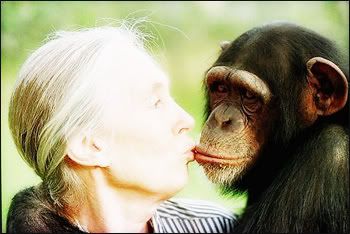
    Jane Goodall


    "These are the kind of things which traditionally have been thought of as human prerogatives. But this teaches us a new respect, and it's a new respect not only for the chimpanzees, I suggest, but some of the other amazing animals with whom we share this planet. Once we're prepared to admit that after all we're not the only beings with personalities, minds, and above all feelings, we'll then start to think about ways we use and abuse so many other sentient, sapient creatures on this planet. It really gives cause for deep shame; at least for me."

    This part of her speech is one of my favorites. It's true that in some ways we are more advanced than other beings, but that doesn't give us the right to treat them as we do now. For ages there have been disputes about respect among humans, but why can't we respect nature and its inhabitants? They aren't inferior; like Jane pointed out, the line that separates humans from animals is very thin. It's a huge disaster when the place you live in is your enemy; without humans, Earth would be one big, peaceful community. When Takers appeared, we were more like intruders that disrupted the planet's natural system and balance rather than the saviors and rulers that we believe we are.

    The next thing she talks about really angers me. Hunters used to kill just enough to support himself and his family, but now with technology, weaponry and roads, they are killing more than they need for profits, thus destroying their culture and "the wonderful way of living for hundreds of years". This is exactly what we're talking about in Ishmael. The Takers' roots started when agriculture began, when we grew more than what was needed. It's a real pity, and we should stop our own expansion over the Leavers before it's too late and these amazing people with incredible knowledge disappear altogether.

    Jane tells us that mostly in the developed areas people are being stupid because of their advancements. We are contaminating our world, and knowing that this will also affect ourselves in a negative way (i.e health), we still continue to do it. This ties in to something she said earlier that we are abusing our power and privileges that come from our knowledge. I remember I said something similar in my second podcast on the summary of Ishmael and it was one of the major points of our "captivity". Is it Mother Culture's fault that we're like this? But then again, even she was born from man's mind. Do we blame our ancestors then? But the fault is also on us because we have chosen continue to live on the principles of Mother Culture. However, this mindset and tradition has been practiced for ages and it's not easy to change.

    What humans have that is distinctively ours is the ability to communicate with sophisticated language, and that is what has brought us so far. We should use that gift wisely and not abuse it at the expense of our planet and everything living in it. Hopefully, like Jane Goodall said at the end of her speech, we can put together our great minds and start making the right decisions.